


Train development news
 Oct 17th 2011 | 9:17 pm
#31

FreeThinker

Joined: Nov 2009
Posts: 9,702
From: the moors and levels


 Re: Train development news
Now I'm really confused. Our little line from Algeciras to Ronda and beyond is wide gauge and I thought that at Bobadilla it changed to standard gauge which is narrower and AVE's run on it. Anybody know? 
Oct 17th 2011 | 9:55 pm
#32

On the road again.
Joined: Aug 2008
Posts: 17,507
From: On Top of the World
Re: Train development news
Maybe I got it wrong way round, no idea really and standard Spanish gauge is wider and the AVE is on standard European or British gauge ?
Oct 17th 2011 | 10:45 pm
#33

Lost in BE Cyberspace
Joined: Feb 2007
Posts: 10,759
From: Land of no recession
Re: Train development news
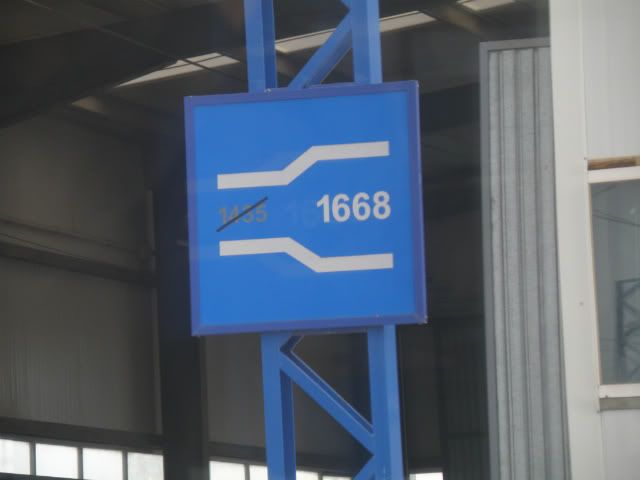
Edit:- link added
http://en.wikipedia.org/wiki/Iberian_gauge
Last edited by Fredbargate; Oct 17th 2011 at 11:04 pm.
Oct 18th 2011 | 12:51 am
#34
On the road again.
Joined: Aug 2008
Posts: 17,507
From: On Top of the World
Re: Train development news
The sign at Bobadilla heading to Algeciras
http://i148.photobucket.com/albums/s...P5180301-2.jpg
Edit:- link added
http://en.wikipedia.org/wiki/Iberian_gauge
http://i148.photobucket.com/albums/s...P5180301-2.jpg
Edit:- link added
http://en.wikipedia.org/wiki/Iberian_gauge
Thanks for that Fred.
It looks like the Spanish and Portugese got their lines badly crossed at various times over the years.
One suggestion is that the Spanish changed from standard gauge to deter future incursions of French trains, not the brightest of moves looking at the situation as it stands now.
Anyway it's reassuring to know that Robert Stevensons original gauge is still almost universally adopted Worldwide and used by hi-speed trains and most others of any importance.
Oct 18th 2011 | 1:23 am
#35
Lost in BE Cyberspace
Joined: Feb 2007
Posts: 10,759
From: Land of no recession
Re: Train development news
I think Isambard Kingdom Brunel's Broad guage would have been the better option in the long run
Oct 18th 2011 | 5:40 am
#36

Thread Starter
Not Banned (yet)
Joined: Aug 2008
Posts: 6,404
From: East Sussex
Re: Train development news
Not being well up or involved with the new train systems, I noticed mention of different gauged tracks.
I presume this limits the new line systems to hi-speed trains only.
I'm curious as to whether these new and I presume wider gauges are only for the AVE, or are they used throughout France,the Channel tunnel and other countries such as Germany ?
Also I wonder why the wider gauge was considered essential as against the standard gauge, maybe it's necessary for extra stability especially on bends ?
Possibly that Cornish guy who built the Worlds first loco and opted for wide gauge had the right idea first time ?
I presume this limits the new line systems to hi-speed trains only.
I'm curious as to whether these new and I presume wider gauges are only for the AVE, or are they used throughout France,the Channel tunnel and other countries such as Germany ?
Also I wonder why the wider gauge was considered essential as against the standard gauge, maybe it's necessary for extra stability especially on bends ?
Possibly that Cornish guy who built the Worlds first loco and opted for wide gauge had the right idea first time ?
They are now putting trains that use this dual system on longer lines that don't have all the way as fast track eg the route from Madrid to Galicia.
http://www.typicallyspanish.com/news...le_32033.shtml
Galicia has witnessed the first test run of a hybrid high speed train anywhere in the world.
The new Alvia S-730 trains can reach 250km/h on high speed tracks, and can be propelled by electricity or diesel on conventional tracks at speeds of 220 and 180 km/hr respectively. They can also run on both Spanish and international gauge tracks.
The new Alvia S-730 trains can reach 250km/h on high speed tracks, and can be propelled by electricity or diesel on conventional tracks at speeds of 220 and 180 km/hr respectively. They can also run on both Spanish and international gauge tracks.
Oct 18th 2011 | 6:03 am
#37
Lost in BE Cyberspace
Joined: Feb 2007
Posts: 10,759
From: Land of no recession
Re: Train development news
Thanks for that Stevie it confirms what I thought was happening under the train from Algeciras to Madrid when it passes through Bobadilla. Obviously you can not see it when riding the train.
The train only stops to change engines, they are not dual gauge, the carriages roll through the gauging machine to continue the journey.
The Algeciras to Bobadilla engines are diesel whilst it's electric units from there to Madrid.
The train only stops to change engines, they are not dual gauge, the carriages roll through the gauging machine to continue the journey.
The Algeciras to Bobadilla engines are diesel whilst it's electric units from there to Madrid.
Oct 19th 2011 | 6:23 pm
#38
On the road again.
Joined: Aug 2008
Posts: 17,507
From: On Top of the World
Re: Train development news
Thanks for that Stevie it confirms what I thought was happening under the train from Algeciras to Madrid when it passes through Bobadilla. Obviously you can not see it when riding the train.
The train only stops to change engines, they are not dual gauge, the carriages roll through the gauging machine to continue the journey.
The Algeciras to Bobadilla engines are diesel whilst it's electric units from there to Madrid.
The train only stops to change engines, they are not dual gauge, the carriages roll through the gauging machine to continue the journey.
The Algeciras to Bobadilla engines are diesel whilst it's electric units from there to Madrid.
I see much on the Spanish news at present about a new Med.corridor for trains and a quite substantial EU grant towards it.
It appears to extend all down the East coast and right along the South also.
Looking at the route much of it seems to be an improvement of existing lines.
I don't see any mention of hi-speed trains so I wonder what they intend to run, as I presume it's meant to speed up the existing routes.
Oct 21st 2011 | 8:32 pm
#39
Thread Starter
Not Banned (yet)
Joined: Aug 2008
Posts: 6,404
From: East Sussex
Re: Train development news
In the new year, you'll be able to travel on a direct high speed train from Malaga to Valencia. I'm not sure how many will want to do this though. It will still take 3 and a half hours, but previously this journey took 8 hours by train.
http://ave-renfe.edreams.es/ave-mala...as-con-el-ave/
http://ave-renfe.edreams.es/ave-mala...as-con-el-ave/
Oct 21st 2011 | 9:09 pm
#40
Lost in BE Cyberspace
Joined: Feb 2007
Posts: 10,759
From: Land of no recession
Re: Train development news
There is talk of a high speed line along the coast from Gibraltar to France
Page ten on this link
http://www.theolivepress.es/print-edition/
Sorry I can't find another link direct to it.
Page ten on this link
http://www.theolivepress.es/print-edition/
Sorry I can't find another link direct to it.
Oct 21st 2011 | 9:31 pm
#41

RETIRED ;-))
Joined: Jul 2003
Posts: 20,156
From: Benalmadena Pueblo,Spain
Re: Train development news
There is talk of a high speed line along the coast from Gibraltar to France
Page ten on this link
http://www.theolivepress.es/print-edition/
Sorry I can't find another link direct to it.
Page ten on this link
http://www.theolivepress.es/print-edition/
Sorry I can't find another link direct to it.

 Oct 26th 2011 | 7:12 am
#42
Thread Starter
Not Banned (yet)
Joined: Aug 2008
Posts: 6,404
From: East Sussex
Re: Train development news
Spanish consortium wins contract to build high speed rail line from Mecca to Medina
http://www.typicallyspanish.com/news...le_32461.shtml
http://www.eleconomista.es/empresas-...-millones.html
http://www.typicallyspanish.com/news...le_32461.shtml
The 6.5 billion € contract is for Phase II of the project, and includes construction of the 450 kilometres of track, signalling and telecommunications systems, electrification, operational control centre and the 35 AVE trains which will operate the line.
The Saudi Railways Organisation said it also includes operation and maintenance for a period of 12 years.
The Saudi Railways Organisation said it also includes operation and maintenance for a period of 12 years.
Oct 26th 2011 | 7:25 am
#43
Joined: Jun 2011
Posts: 12,053
From: In the middle of 10million Olive Trees
Re: Train development news
Spanish consortium wins contract to build high speed rail line from Mecca to Medina
http://www.typicallyspanish.com/news...le_32461.shtml
http://www.eleconomista.es/empresas-...-millones.html
http://www.typicallyspanish.com/news...le_32461.shtml
http://www.eleconomista.es/empresas-...-millones.html
Oct 26th 2011 | 7:31 am
#44
Thread Starter
Not Banned (yet)
Joined: Aug 2008
Posts: 6,404
From: East Sussex
Re: Train development news
Of course once you start to build a reputation, you can start to win orders in the same industry. For example this order from New Zealand.
http://www.stuff.co.nz/auckland/loca...land-train-job
Oct 31st 2011 | 11:56 pm
#45
FreeThinker
Joined: Nov 2009
Posts: 9,702
From: the moors and levels
Re: Train development news
Bit more news on the Costa del Sol developments
FOREIGN Minister Trinidad Jimenez described a train service to cover the length of the Costa del Sol as an “absolute necessityâ€.
Jimenez, who is also the socialist party’s number one candidate in Malaga for the Chamber of Deputies, has said that the PSOE promises to create the route which would extend the existing section between Malaga and Fuengirola along the coast towards Algeciras, as she says it has “huge potentialâ€.
Despite this, businesses along the coast are worried that the train to Marbella and Estepona may not become reality, especially since the EU recently revealed that plans for the Mediterranean Railway Route which is to run through Spain from the border with France to Algeciras will not go along the Malaga coast but instead take the route inland.
The Ministry of Public Works announced that the project would require an investment of €19.4 billion between 2014 and 2020 and locals fear that this will mean there will be no funds for the coastal train.
Jimenez, who is also the socialist party’s number one candidate in Malaga for the Chamber of Deputies, has said that the PSOE promises to create the route which would extend the existing section between Malaga and Fuengirola along the coast towards Algeciras, as she says it has “huge potentialâ€.
Despite this, businesses along the coast are worried that the train to Marbella and Estepona may not become reality, especially since the EU recently revealed that plans for the Mediterranean Railway Route which is to run through Spain from the border with France to Algeciras will not go along the Malaga coast but instead take the route inland.
The Ministry of Public Works announced that the project would require an investment of €19.4 billion between 2014 and 2020 and locals fear that this will mean there will be no funds for the coastal train.
