


Pension taxation
 Dec 12th 2023 | 9:48 pm
#1
Thread Starter
Just Joined
Joined: Feb 2022
Posts: 12

 Pension taxation
Quick question on UK pensions. If I were to become a tax resident in PT, and obviously non-tax resident in the UK, is it possible to continue to have just the pension taxed in the UK without being a tax resident?
Due to not being in the NHR, I don't want the pension taxed in PT at 48%, but as I will not be a UK tax resident anymore, I am not sure if I am able to just have the pension taxed there and then take advantage of the double taxation treaty to not be taxed on the pension in PT at all.
I am pretty sure you can just have the pension taxed in the UK anyway without being tax resident there but want to double check now that the NHR (for pensions) is ending. I will have both state and private pensions (I think the state one may be taxed in the uk regardless but not so sure about the private ones)
Due to not being in the NHR, I don't want the pension taxed in PT at 48%, but as I will not be a UK tax resident anymore, I am not sure if I am able to just have the pension taxed there and then take advantage of the double taxation treaty to not be taxed on the pension in PT at all.
I am pretty sure you can just have the pension taxed in the UK anyway without being tax resident there but want to double check now that the NHR (for pensions) is ending. I will have both state and private pensions (I think the state one may be taxed in the uk regardless but not so sure about the private ones)
Last edited by ewokuk; Dec 12th 2023 at 10:06 pm.
Dec 12th 2023 | 10:48 pm
#2

BE Enthusiast

Joined: Oct 2019
Posts: 703

 Re: Pension taxation
First thing, what kind of pension are you talking about? Private, gov or state pension?
You dont get to pick and choose your taxes. Taxes are liability, which depend on your residence.
I dont think you understand how double taxation treaties work.
Gov based pension will always be first taxed in UK and exempt for tax in PT. UK is in process of renegotiating tax treaty with PT, but there wont be major changes.
You dont get to pick and choose your taxes. Taxes are liability, which depend on your residence.
I dont think you understand how double taxation treaties work.
Gov based pension will always be first taxed in UK and exempt for tax in PT. UK is in process of renegotiating tax treaty with PT, but there wont be major changes.
Dec 13th 2023 | 1:24 am
#4

Polished expat
Joined: Jul 2014
Posts: 18,683
From: Arcos de Valdevez "Onde Portugal se fez"
Re: Pension taxation
Residents of Portugal are taxed in Portugal on their worldwide income, except where a tax treaty gives the source country tax rights. Residency can be determined in various ways but suffice to say that if you are a UK national with no other citizenship and want to become resident for immigration purposes nowadays, that will also make you tax resident. Worldwide income means income from all sources, so if you have any income from savings and investments, rental income etc that all gets taken into consideration along with pension income even if it all arises outside PT.
Government pensions referred to above do not include the UK State Pension - the UK / Portugal tax treaty stipulates that pensions in respect of work for the public sector are taxed solely in the source country. Other pensions, including the state pension, are taxed solely in the country of residence.
Your wish not to be taxed at 48% on your pensions, however, can be granted. Tax in Portugal is levied in bands, with each rate applying to income between the lower and upper limits per band. This year's table looks thus :
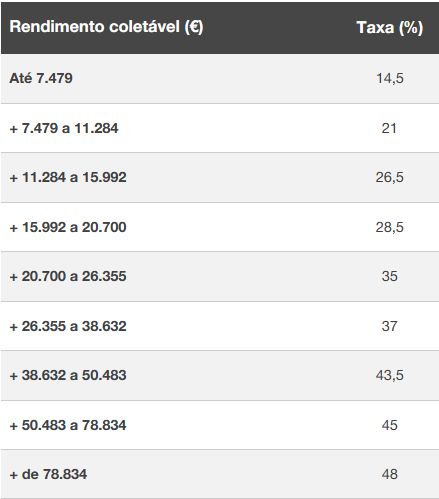
Only income in excess 78,834€ is taxed at 48%. In fact, it's slightly better even than that - you get a deduction from pension income of 4,104€ to arrive at the taxable income figure prior to applying the appropriate rates per band.
For a worked example, imagine you had 40,000€ total pension. You get 4,104€ deduction to give a taxable figure of 35,896€, which would result in a gross tax of 9,982.40€ (a shade under 25% of the income). There are some deductions which would reduce the actual tax by a variable amount depending on various categories of expenditure. Somewhere in the hundreds, and at the very least 250€.
Government pensions referred to above do not include the UK State Pension - the UK / Portugal tax treaty stipulates that pensions in respect of work for the public sector are taxed solely in the source country. Other pensions, including the state pension, are taxed solely in the country of residence.
Your wish not to be taxed at 48% on your pensions, however, can be granted. Tax in Portugal is levied in bands, with each rate applying to income between the lower and upper limits per band. This year's table looks thus :
For a worked example, imagine you had 40,000€ total pension. You get 4,104€ deduction to give a taxable figure of 35,896€, which would result in a gross tax of 9,982.40€ (a shade under 25% of the income). There are some deductions which would reduce the actual tax by a variable amount depending on various categories of expenditure. Somewhere in the hundreds, and at the very least 250€.
Dec 15th 2023 | 12:28 am
#5
Just Joined
Joined: Sep 2023
Posts: 22
From: UK
Re: Pension taxation
Residents of Portugal are taxed in Portugal on their worldwide income, except where a tax treaty gives the source country tax rights. Residency can be determined in various ways but suffice to say that if you are a UK national with no other citizenship and want to become resident for immigration purposes nowadays, that will also make you tax resident. Worldwide income means income from all sources, so if you have any income from savings and investments, rental income etc that all gets taken into consideration along with pension income even if it all arises outside PT.
Government pensions referred to above do not include the UK State Pension - the UK / Portugal tax treaty stipulates that pensions in respect of work for the public sector are taxed solely in the source country. Other pensions, including the state pension, are taxed solely in the country of residence.
Your wish not to be taxed at 48% on your pensions, however, can be granted. Tax in Portugal is levied in bands, with each rate applying to income between the lower and upper limits per band. This year's table looks thus :
Only income in excess 78,834€ is taxed at 48%. In fact, it's slightly better even than that - you get a deduction from pension income of 4,104€ to arrive at the taxable income figure prior to applying the appropriate rates per band.
For a worked example, imagine you had 40,000€ total pension. You get 4,104€ deduction to give a taxable figure of 35,896€, which would result in a gross tax of 9,982.40€ (a shade under 25% of the income). There are some deductions which would reduce the actual tax by a variable amount depending on various categories of expenditure. Somewhere in the hundreds, and at the very least 250€.
Government pensions referred to above do not include the UK State Pension - the UK / Portugal tax treaty stipulates that pensions in respect of work for the public sector are taxed solely in the source country. Other pensions, including the state pension, are taxed solely in the country of residence.
Your wish not to be taxed at 48% on your pensions, however, can be granted. Tax in Portugal is levied in bands, with each rate applying to income between the lower and upper limits per band. This year's table looks thus :
Only income in excess 78,834€ is taxed at 48%. In fact, it's slightly better even than that - you get a deduction from pension income of 4,104€ to arrive at the taxable income figure prior to applying the appropriate rates per band.
For a worked example, imagine you had 40,000€ total pension. You get 4,104€ deduction to give a taxable figure of 35,896€, which would result in a gross tax of 9,982.40€ (a shade under 25% of the income). There are some deductions which would reduce the actual tax by a variable amount depending on various categories of expenditure. Somewhere in the hundreds, and at the very least 250€.
Just to confirm - in the situation where in receipt of UK state pension and UK Private Pension (non-govt) when PT resident: these are both PT taxable only?
How does one advise UK pension providers not to deduct UK tax once PT resident?
Thanks
Dec 15th 2023 | 1:06 am
#6
Polished expat
Joined: Jul 2014
Posts: 18,683
From: Arcos de Valdevez "Onde Portugal se fez"
Re: Pension taxation
How does one advise UK pension providers not to deduct UK tax once PT resident?
You submit that, together with the completed HMRC form DT-Individual to HMRC, who will instruct your pension provider to use the NT code on your pension and not deduct any tax.
Dec 15th 2023 | 1:27 am
#7
Just Joined
Joined: Sep 2023
Posts: 22
From: UK
Re: Pension taxation
Correct.
You have to get a Certidão de Residência Fiscal (make sure it's specifically this that you request, not the similarly-named Certidão de DomicÃlio Fiscal) online from the Financas portal. To do this, from the first page, select Todos os Serviços / Documentos e Certidões / Pedir Certidão and select the correct option from the drop-down list. Leave item 5 blank when you make the request - I think the others are self-explanatory.
You submit that, together with the completed HMRC form DT-Individual to HMRC, who will instruct your pension provider to use the NT code on your pension and not deduct any tax.
You have to get a Certidão de Residência Fiscal (make sure it's specifically this that you request, not the similarly-named Certidão de DomicÃlio Fiscal) online from the Financas portal. To do this, from the first page, select Todos os Serviços / Documentos e Certidões / Pedir Certidão and select the correct option from the drop-down list. Leave item 5 blank when you make the request - I think the others are self-explanatory.
You submit that, together with the completed HMRC form DT-Individual to HMRC, who will instruct your pension provider to use the NT code on your pension and not deduct any tax.

 Dec 21st 2023 | 2:50 am
#9
Forum Regular
Joined: Feb 2008
Posts: 202
 Re: Pension taxation
Correct.
You have to get a Certidão de Residência Fiscal (make sure it's specifically this that you request, not the similarly-named Certidão de DomicÃlio Fiscal) online from the Financas portal. To do this, from the first page, select Todos os Serviços / Documentos e Certidões / Pedir Certidão and select the correct option from the drop-down list. Leave item 5 blank when you make the request - I think the others are self-explanatory.
You submit that, together with the completed HMRC form DT-Individual to HMRC, who will instruct your pension provider to use the NT code on your pension and not deduct any tax.
You have to get a Certidão de Residência Fiscal (make sure it's specifically this that you request, not the similarly-named Certidão de DomicÃlio Fiscal) online from the Financas portal. To do this, from the first page, select Todos os Serviços / Documentos e Certidões / Pedir Certidão and select the correct option from the drop-down list. Leave item 5 blank when you make the request - I think the others are self-explanatory.
You submit that, together with the completed HMRC form DT-Individual to HMRC, who will instruct your pension provider to use the NT code on your pension and not deduct any tax.
I did exactly what you have said over a year ago and haven,t heard a dickybird. Neither have my pension providers.
Suspect I will be spending considerable time in HMRC phone queues next year !
We bemoan the Portuguese system sometimes but It seems that things are no better in UK
Dec 22nd 2023 | 1:38 am
#10
Polished expat
Joined: Jul 2014
Posts: 18,683
From: Arcos de Valdevez "Onde Portugal se fez"
Re: Pension taxation
That,s the theory but in practice I,m not sure.
I did exactly what you have said over a year ago and haven,t heard a dickybird. Neither have my pension providers.
Suspect I will be spending considerable time in HMRC phone queues next year !
We bemoan the Portuguese system sometimes but It seems that things are no better in UK
I did exactly what you have said over a year ago and haven,t heard a dickybird. Neither have my pension providers.
Suspect I will be spending considerable time in HMRC phone queues next year !
We bemoan the Portuguese system sometimes but It seems that things are no better in UK
In my own case, it wasn't completely without hitches. First up, I had trouble getting the PT process to cough up the certidão. A quick bit of research told me a bit of stickiness here is not unusual and repeated attempts the only remedy, so I did that and got one some days later.
When I posted that and the HMRC form, I sent it registered so I could track it and know that it arrived and when (I know - but experience has taught me its best to know these things). That was all fine and dandy and I did see it get through but the response was unexpected - they returned the lot & told me it had been rejected for lack of a stamp on the part of the PT tax authority. I had specifically ascertained both from HMRC's own explanatory notes and PT's instructions that the tax office here no longer stamps forms and the only one they issue is the one mentioned here, and that HMRC accepts stand-alone certificates from jurisdictions which won't stamp their form. So I had to clear that up via a phone call (and surprisingly no further action required on my part after that). And I got new tax codes and tax refunds on payslips as well as a cheque from HMRC for refund of the previous year tax overpayment.
Out of interest, is your pension a standard set amount per month PAYE affair from a workplace pension? I'd definitely have chased up a bit earlier in your shoes - no activity at all seems to indicate something gone astray, rather than stuck in a backlog or something.
Dec 22nd 2023 | 2:28 am
#11
Forum Regular
Joined: Feb 2008
Posts: 202
Re: Pension taxation
Thanks for the info, was your experience pre or post Covid ?
There is not a great deal of money involved in my case, so a delay in processing isn,t the end of the world.
As said, I,ll begin the follow up in the New Year.
There is not a great deal of money involved in my case, so a delay in processing isn,t the end of the world.
As said, I,ll begin the follow up in the New Year.
Dec 22nd 2023 | 7:33 am
#12
Polished expat
Joined: Jul 2014
Posts: 18,683
From: Arcos de Valdevez "Onde Portugal se fez"
Re: Pension taxation
I started the process in July 2022 and it was all completely done and dusted by about the end of October. I probably dilly-dallied a bit on my part during the early part of it so it could be more rapid, I guess. But that seems a pretty reasonable timescale to me, even if it had been (avoidably) delay-free both sides.

